

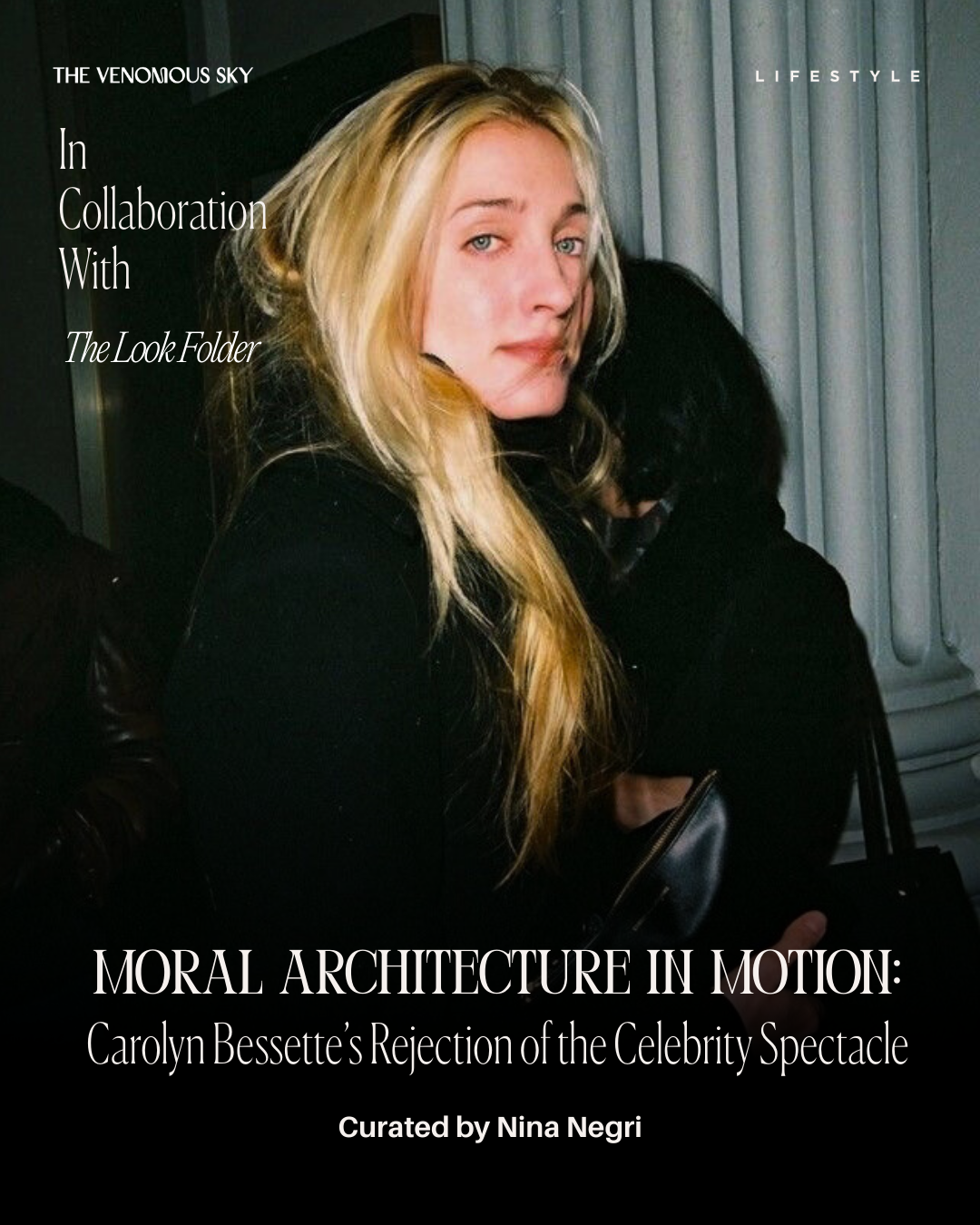
By Nina Negri in collaboration with The Look Folder
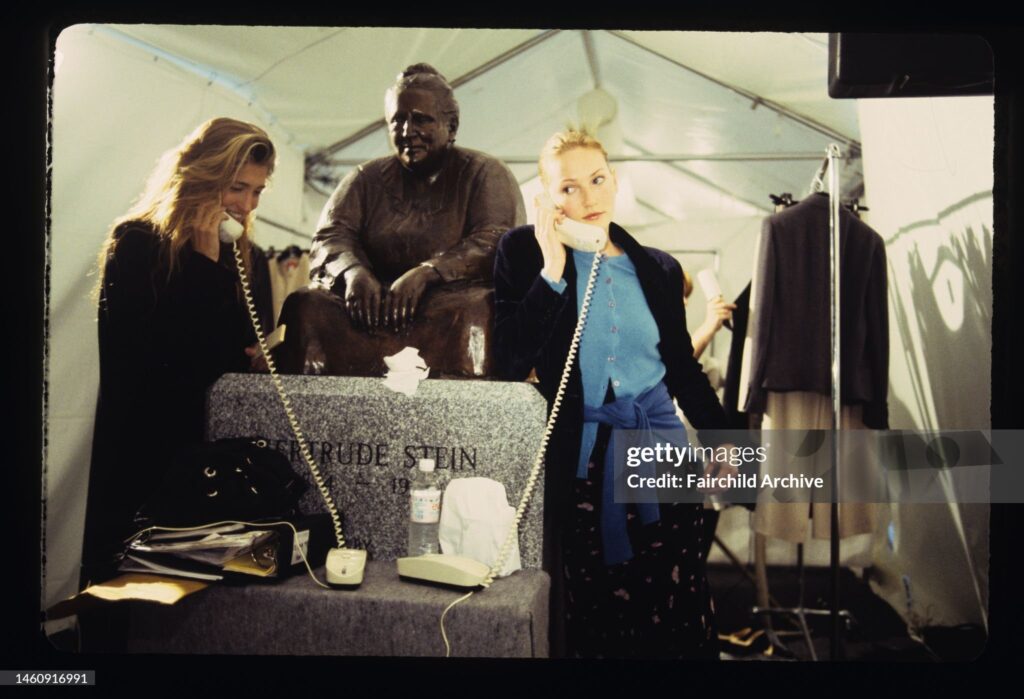
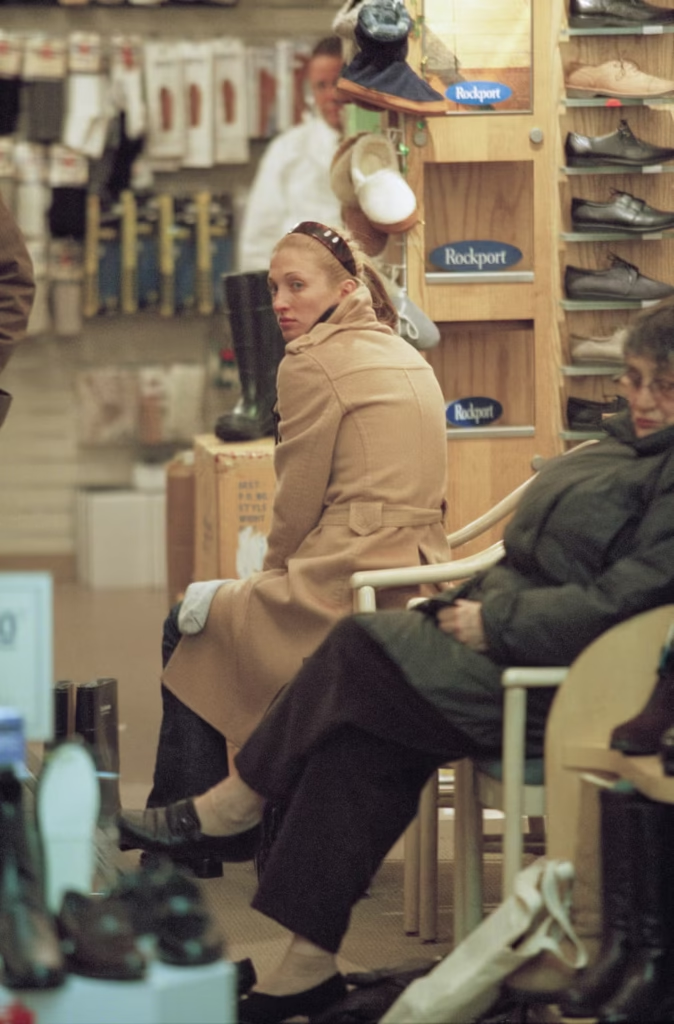
There is a silent pressure to be perpetually available. Absence has become synonymous with suspicion, and silence is now a widely misinterpreted strategy. In the attention economy, to exist is to perform.
At the dawn of the digital age, visibility became an inflated currency. From the grueling cycles of trends to the exhaustive performance of an algorithm-mediated lifestyle, the human experience has been turned into raw material for an uninterrupted stage set. Yet, nearly thirty years before the first algorithm, Carolyn Bessette-Kennedy emerged: the quietest person in the room, which automatically made her the most interesting person in sight.
I. How a life built around minimal advocacy restructures visibility itself.
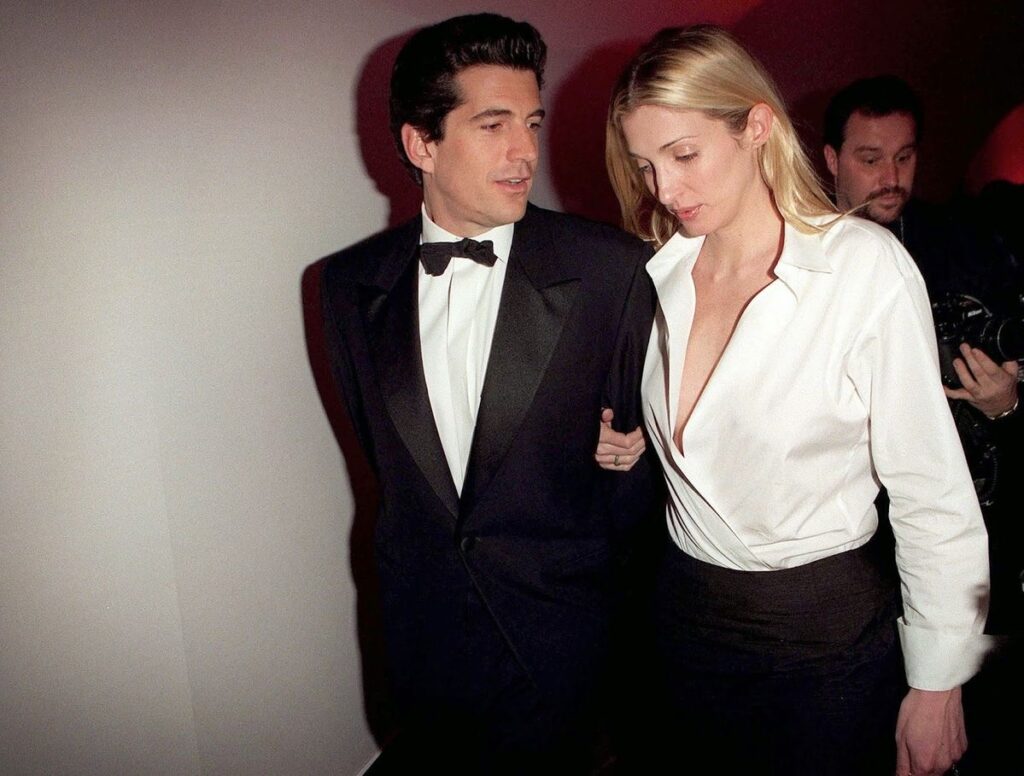
Let us go back to the 1990s, a decade when gossip headlines became omnipresent through the “tabloidization” of American media. Interestingly, as mass culture grew louder, “Quiet Luxury” and minimalism were adopted as the dominant language of aesthetic rationality – driven by desire, rising consumption, and a reaction against the excess of the previous decade. But here, CBK had already sketched what we might call a “moral architecture.” Born in 1966 in the affluent suburb of White Plains, New York, Carolyn was the youngest of three children. She began her career as a sales assistant at Calvin Klein in Boston, but her authenticity and talent quickly propelled her to the role of Director of Publicity at the Manhattan headquarters. It was during this time she met John F. Kennedy Jr., the son of the former U.S. President, whom she married in 1996.
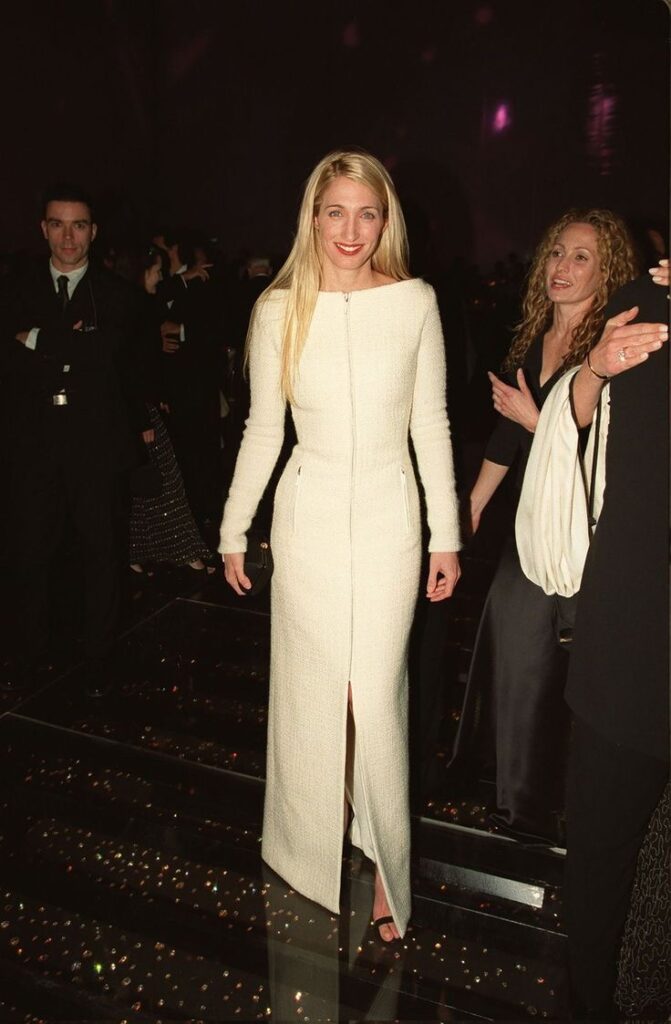
Carolyn transformed into a symbol, an archetype. The obsession society held and still holds – for her is fueled by the unknown that springs from our own gaps: the lack of answers about Carolyn turns her into a “white noise” that forces the spectator out of passivity. If you wanted to know who CBK was, you had to look at her actions, not her photos. An unbuttoned white shirt, Levi’ s 517 bootcut jeans, and tortoiseshell headbands; or perhaps a floor-length black skirt by Yohji Yamamoto. Nothing screamed. Nothing competed. Nothing demanded constant emotional interpretation. She wasn’t just “doing minimalism”; she was engaged in a strategic narrowing of focus.
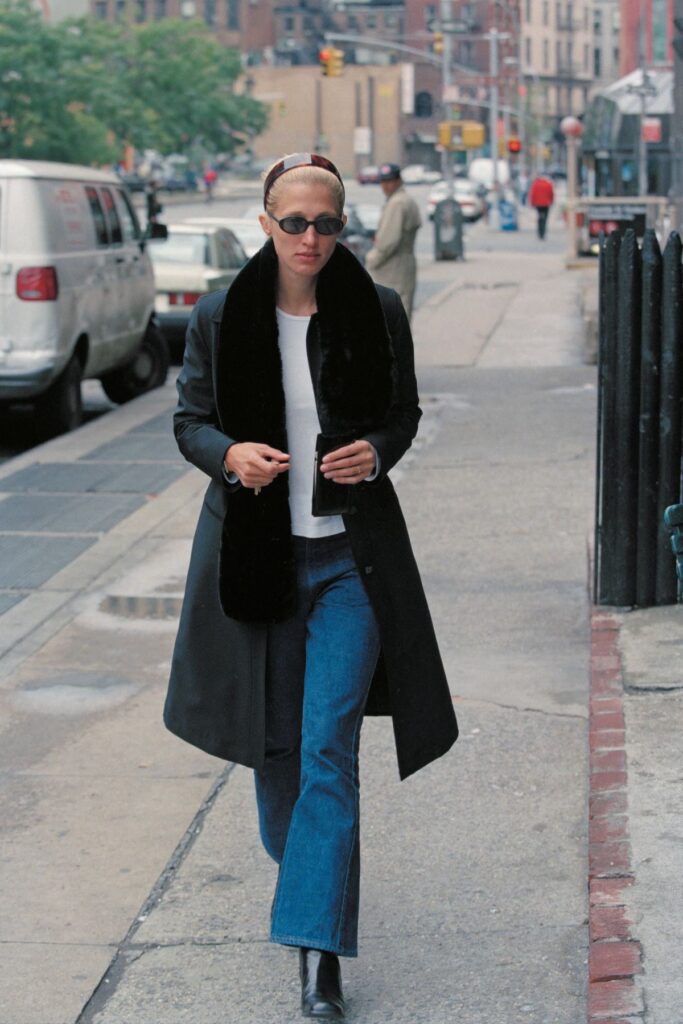

II. Restraint as a deliberate refusal of spectacle culture.
She possessed an almost liturgical habit: removing labels from her couture pieces as a definitive act of de-commodification. Carolyn consumed objects for their construction, quality, and utility, rather than as social billboards. By eliminating “glamour” – the feathers, the glitter, the logos, and the noise of trend-chasing, she reclaimed the mental and temporal resources necessary to sustain a public persona. She was not a passive “it-girl”; she was an insurgent using minimalism to protect her self-determination. Bessette proved that one can occupy the epicenter of culture without becoming a commodity. While the spectacle demands that public figures be ornamented, photographed, and consumed, she treated her image as non-negotiable. In 2023, Vanessa Friedman defined her as a “Ghost Influencer” for having a perceptible impact on trends in an era defined by excess and performative charisma. The idea of someone who influenced without a profile, without giving interviews, and without selling anything is the pinnacle of “rebellious authenticity.” By adopting a functional visibility, Carolyn refused to be consumed.
For Bessette, minimalism was a tool of “visual silence.” In this context, every choice passed through a filter: does this serve the mission? If not, it is discarded. By simplifying her look to the extreme, she broke the social relationship mediated by image; there was nothing “new” for the public to consume, only the repetition of the essential. Carolyn offered nothing but purpose. She never gave a formal interview during her marriage, a deliberate refusal to participate in the “Society of the Spectacle” described by Guy Debord in 1967, where life is no longer about being, but about appearing. She refused to provide the “fuel” the spectacle demands: constant novelty. By opting for the discreet, the practical, and the essential, she protected the integrity of her work and her private life. This was also a tactic of political survival. Upon joining the Kennedy family, she inherited not just a last name, but a mythology burdened with tragedies and performative expectations she refused to fulfill.
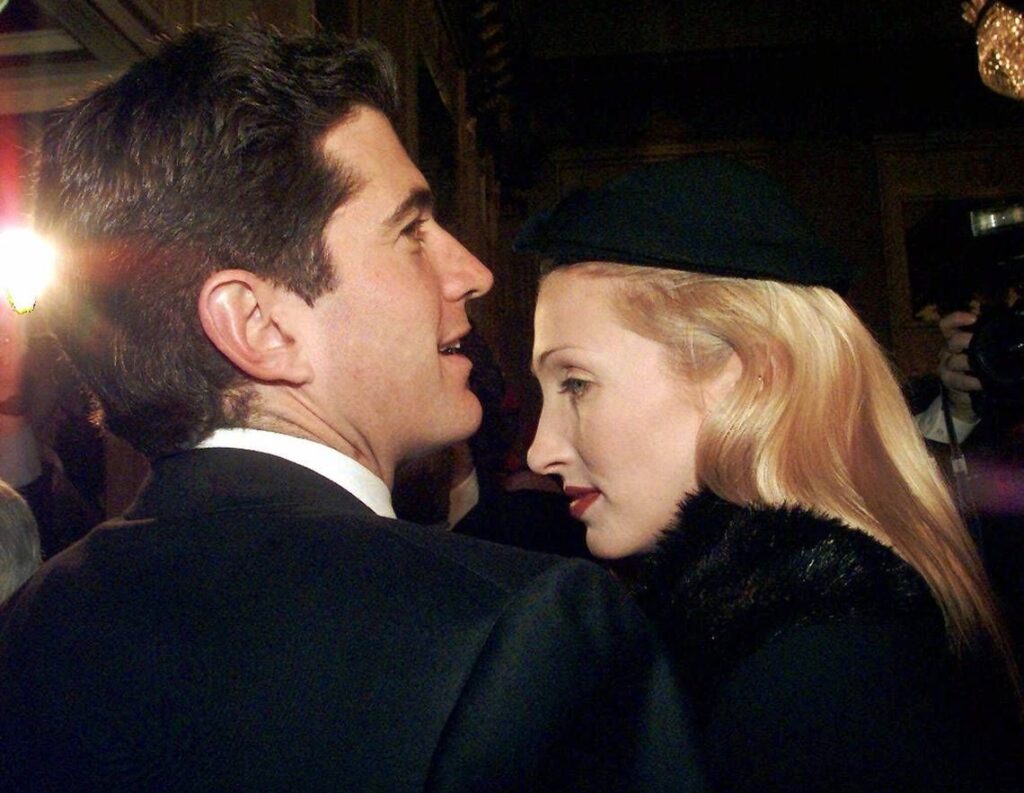
III. Advocacy as a daily design principle.
In the 90s, before Carolyn’s aesthetic was co-opted by greenwashing campaigns and pre-packaged sustainability discourses, she understood that in a market saturated with visual stimuli, absence becomes a far more compelling language. We cannot reduce CBK to mere minimalism; she became a symbol of aesthetic and emotional integrity. Today, we live in an era of hyper-consumption, where micro-trends and micro-aesthetics are born and discarded with a single click, resulting in a culture of disposable clothing and identities. Carolyn represents a value system where repetition becomes a radical gesture. The choice to re-wear the same white shirt or the same black coat was an implicit refusal of the logic of planned obsolescence. Her wardrobe consisted of pieces designed to last years, not cycles, clothes that age with the body rather than being discarded at the first sign of symbolic wear.
At this moment, the figure of Carolyn Bessette-Kennedy returns not as aesthetic nostalgia, but as a haunting
question:
Is it possible to exist publicly without becoming a commodity?
Her answer was partial, imperfect, but instructive. Because, in the end, the spectacle requires our collaboration. And refusing to collaborate remains, even today, a form of power. Perhaps this is the legacy resurfacing with strength in an era of disposable micro-trends and identities molded by digital validation: the possibility of existing without exhausting oneself in performance. That repeating can be more revolutionary than innovating. And that, amidst the excess of stimuli, silence when deliberate, is not empty.
It is intentional.