

BREAKING INTO A MALE-DOMINATED INDUSTRY
What challenges have you faced as a woman designing heels in a male-led industry, and how have you overcome them?
I approach design from a practical standpoint rather than theory, or trends. I knew exactly what I wanted to create. I was told that certain heel heights wouldn’t work because women prefer shorter heels, I disagreed. Women don’t necessarily want lower heels, they want comfort, and that comes from thoughtful design, not just reducing height.
One of the biggest gaps I’ve noticed is that men designing women’s shoes often rely on existing templates rather than rethinking what works. That’s why we keep seeing the same old narrow, tight closed-toe stilettos.
But when women who actually wear heels saw my designs, they immediately connected with them. That acknowledgment was all I needed!
Rather than a struggle, I see my presence in this space as an opportunity; for the industry, for customers, and for the evolution of high heels themselves.
DESIGNING FROM EXPERIENCE: ACTUALLY, WALKING A MILE IN A WOMAN’S SHOE
How does your firsthand experience of wearing heels influence Ugra’s design philosophy?
I have been wearing heels for over 15 years now, I would wear them to work from 9am until 7pm and sometimes beyond. For me, heels have to be comfortable first, then they have to be beautiful. These two factors are my guiding principles
Before launching Ugra, I wore my designs every day for about a year. I wanted to be sure they were the best they could be. Along the way, I made small design tweaks until I was fully satisfied. Even now, every new design follows the same process. I create, get a prototype made, wear it daily, refine it, and remake it if needed. Only when I’m completely convinced do they go out into the world for others to wear.
Can you share an example of a personal discomfort you’ve transformed into a design solution?
So many. Every bit of Ugra has a reason, I Will tell you my top 3:
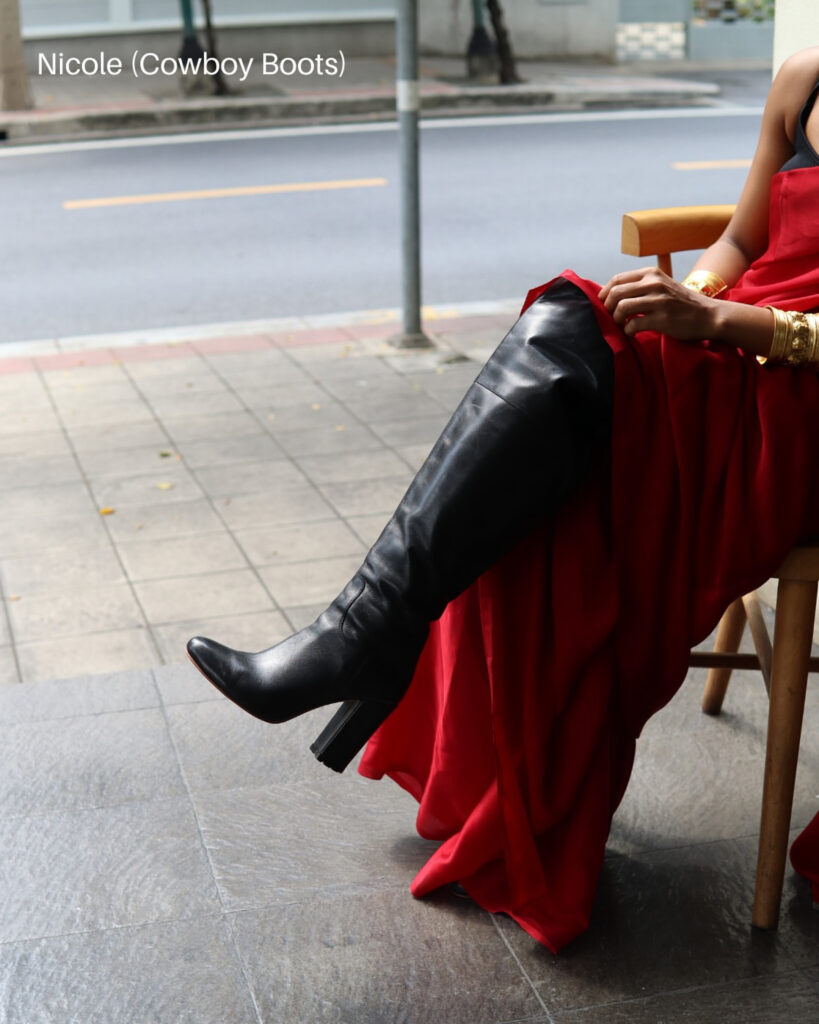
Our Indian roads are not meant for stilettos, I have twisted my ankle once. So, block heels.
All our shoes are in sturdy block heels which you can comfortably wear all-day-long.
I designed Amrita (the big bow boots) and Rina (the Sandals) with an open-toe design for breathability and space to wear toe rings. In India love, we love our toe rings and don’t want to remove them every time we wear shoes.
Lastly, for me shoes must last. Fast fashion has ruined the quality of everything, but shoes are non-negotiable. So, we make them in leather, even the lining. The thing with real leather is it gets better with time. It develops a beautiful shine, becomes softer, and molds to your feet’s unique shape. And they really last long.
THE “FEMALE GAZE” ON FIT AND FORM
Why do you think comfort and size inclusivity have been overlooked in heel design globally?
Two things:
Mostly heels are designed by men, and they’ve never had to wear them. So, the focus has been more on how they look rather than how they feel. That’s why we see these impossibly narrow, tight-fitting, sky-high stilettos that are hard to walk in.
Then there’s the industry standard of beauty and a pressure to scale a business. Most brands stick to a limited size range, assuming anything beyond that is “uncommon” or “not in demand.”
In what ways do your heels celebrate femininity and power beyond just aesthetics?
Power and femininity are feelings and one can only communicate that via visuals and storytelling. So every piece of content that goes out, and everything we do, I ask: how does it make my people feel?
So yeah, we never celebrate the shoes, the wearers are our protagonists.
UGRA’S APPROACH TO DESIGN
What does the name Ugra signify, and how does it reflect your brand’s ethos?
Growing up, I was called Ugro, in Bengali, it means “too much.” Be less. Less fashionable, less opinionated, less smart. As a kid, it made me feel like I didn’t belong. Like most girls, I struggled, unsure of who to be or how to be. I loved wearing heels, but my parents wouldn’t allow it. So, I would hide and wear them, then tuck them back in my house.
When I was sketching the first designs, the word came back to me. I looked it up and realized it wasn’t just Bengali, Ugra was in Sanskrit, in Tamil, and in almost every Indian language. It means fierce. It was perfect. I had my brand name. Ugra.
You have no idea the joy it gives me when I hear people say it, Ugra! Hahaha I hope these shoes inspire women to be just that. When we walk in, the sound of our heels should be the drumroll to our entrance. We celebrate being too much, we are fierce, we are seen, and we must be heard.
How does Ugra aim to put its leather workmanship on the global map?
A rich heritage in leather craftsmanship, with cities like Agra, Chennai, and Kolkata producing high-quality leather goods for major luxury brands in the world. But we don’t make anything with our name on it. I hope to change that with Ugra. We proudly say Handcrafted in India.